Denver Gastroenterologists Helping Patients Like You
Welcome to the Hemorrhoid Center of Colorado at Gastroenterology of the Rockies. We offer quick hemorrhoid procedure known as hemorrhoid banding in Denver and our seven clinics throughout the metro area.
With hemorrhoid banding, no sedation is needed. Some patients report that they can return to their regular routines with minimal disruption.
Conveniently book a quick hemorrhoid treatment over your lunch hour.
We hear it all the time, how hemorrhoid symptoms can disrupt your day. If you’re ready to try something different, ask about this minimally invasive procedure then decide if it’s right for you. Still have questions? Ask one of our gastroenterologists today.
What is the difference between
internal vs external hemorrhoids?
To diagnose hemorrhoids, a doctor will perform a physical exam and check the anus and rectum for any signs of swelling, bleeding or other symptoms. In some cases, the doctor may recommend a colonoscopy or sigmoidoscopy to examine the inside of the rectum and colon.
At Gastroenterology of the Rockies and Hemorrhoid Center of Colorado, our gastroenterologists diagnose piles, also known as hemorrhoids.
Internal Hemorrhoids
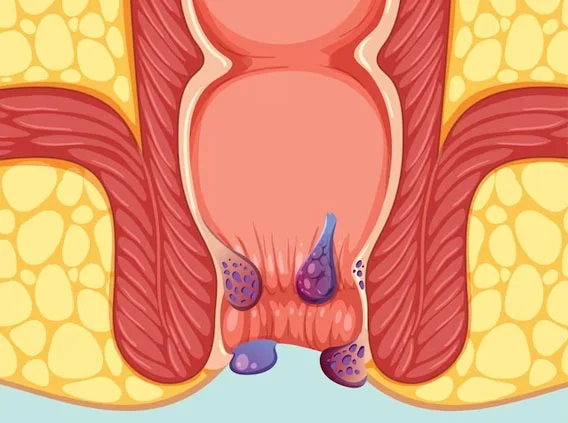
Internal hemorrhoids form inside the anal canal and are usually small. They may bulge outward during bowel movements, causing discomfort or bleeding when nearby muscles press against swollen veins.
External Hemorrhoids
External hemorrhoids typically feel more uncomfortable or sensitive when the overlying skin becomes irritated. Compared to internal hemorrhoids, patients report more discomfort when hemorrhoids bulge. Most common symptoms are itching, bleeding, swelling, and pain.
Hemorrhoid Banding is not performed on external hemorrhoids.
Internal and external hemorrhoids share some common symptoms. Have you experienced any of these symptoms? If you have questions about hemorrhoid treatment, book a consultation with one of our GI specialists.
Bleeding during bowel movements
Itching
Leakage in
underwear
Rectal pain when cleaning the rectal area
Swelling
What Causes Hemorrhoids?
Generally, hemorrhoids are caused by too much pressure on the veins in the pelvic and rectal area. This can cause tissue to swell and stretch. Here are some factors that cause increased pressure:
Constipation and diarrhea
Straining during a bowel movement
Pregnancy adds pressure to the pelvic area
Childbirth during labor and pushing
Hemorrhoids are more common by age 50
Why is there blood in my stool?
It’s important to let your GI doctor or PA know if you have blood in your stool because it can help them rule out other digestive conditions. Bloody stool is commonly found with anal fissures and rectal tumors. It can sometimes be seen in people with colitis and colon cancer.
Diagnosis & Treatment
Diagnosing Hemorrhoids
How are hemorrhoids diagnosed?
Let your doctor know about hemorrhoid symptoms you have recently experienced. Also, inform them if you are using any medications or topical treatments for relief. To determine whether you have internal or external hemorrhoids, your doctor will use the following methods.
Rectal exam
Diagnosis & TreatmentColonoscopy or sigmoidoscopy screening
Sigmoidoscopy is a less invasive procedure which shows the lower portion of the rectum only
Treatment Options for Hemorrhoids
For many people with hemorrhoids, over-the-counter ointments may relieve hemorrhoid symptoms, like pain, swelling and itching. Medications may contain ingredients like hydrocortisone, witch hazel or numbing agents.
In addition to topical medications, oral medications such as pain relievers, stool softeners and laxatives may also help to ease symptoms and promote healing.
Additionally, try to gradually increase fiber in your diet and drink more water to alleviate symptoms.
Prevent Hemorrhoids with These Tips
Lifestyle Changes Can Help with Hemorrhoids
How are hemorrhoids prevented? When it comes to preventing hemorrhoids, adopting a few lifestyle changes can go a long way. Proper nutrition, hydration and paying attention to your natural bodily urges to use the restroom can make a difference. Here are a few more prevention tips.
Avoid sitting on the toilet for more than five minutes
Do not strain during a bowel movement
Notice the urge to defecate and use the toilet right away, rather than waiting
Find foods with insoluble fiber to help prevent constipation [Source: Medical News Today]
Reach for beans, oats, broccoli, nuts, and soluble fiber to help feel full and satiated
When using fiber supplements, gradually add them to the diet and consume lots of fluids
What Should I Do When At-Home Remedies for Hemorrhoids No Longer Work?
When the usual at-home treatments for hemorrhoids don’t work, or you develop severe and persistent hemorrhoids, there are alternative treatments to consider.
In-office procedures like hemorrhoid banding can be performed with internal hemorrhoids. This minimally invasive, non-surgical procedure requires no sedation or bowel prep drink. Many people have told us they’re able to safely return to normal daily activities the same day.
Curious about treatments for hemorrhoids? Ask us about hemorrhoid banding. Browse our branch locations to set up an office visit today.
Surgeons perform surgery to remove internal or external hemorrhoids when other treatments no longer work. Hemorrhoidectomy is a surgical procedure that is often used to remove large or severe hemorrhoids.
Treatment Options for Hemorrhoids
Surgeons perform surgery to remove internal or external hemorrhoids when other treatments no longer work. Hemorrhoidectomy is a surgical procedure that is often used to remove large or severe hemorrhoids.
Hemorrhoid Banding–an Effective Treatment
Find Out If Hemorrhoid Banding is Right For You
At the Hemorrhoid Center of Colorado, our GI specialists use the CRH O’Regan System® for hemorrhoid banding, or rubber band ligation. Many patients report that this quick procedure has little to no pain. We use the banding method because it’s a proven and effective solution for people who experience internal hemorrhoids.[i]
Best of all, banding only takes a few minutes. Since there is no need for preparation or sedation, many patients can return to work the same day.
This short video explains the procedure.
What to Expect with Hemorrhoid Banding Treatments
Hemorrhoid Banding is a non-surgical treatment option for internal hemorrhoids. The procedure works by cutting off the blood supply to the hemorrhoid with a small rubber band. The effectiveness of this treatment lasts for approximately four to five years. Most patients do require more than one banding treatment to fully treat their internal hemorrhoids.
To see the best results with hemorrhoid banding, we recommend two to three office visits. That’s because the anatomy of hemorrhoids is sometimes structured in three separate columns. Each treatment targets one column at a time. It is not recommended to treat all columns simultaneously.
About two to four days after a banding treatment, the hemorrhoid will shrink and fall off with the band. Over the next two weeks, you may see small amounts of blood on toilet paper after bowel movements and this is normal.
First Visit
Think of your first visit as an evaluation by your GI specialist to determine whether you have a treatable internal hemorrhoid or if there’s another reason for pain or bleeding.
In some cases, you can be evaluated and treated the same day, unless you have underlying conditions, like an anal fissure. In this case, your GI specialist may offer a topical cream and ask you to schedule the procedure in a few weeks. This allows any pain and swelling to dissipate before the banding procedure.
During the banding treatment, you will be instructed to lie on your left side. Then, your specialist will use an anoscope to look at the area internally. If an internal hemorrhoid is found, and you are an appropriate candidate, they will proceed with the banding procedure. You will be asked to stay at the clinic for approximately 10 minutes after the procedure to make sure you are not having any pain.
Second Visit and Third Visit
For the second and third office visits, these are scheduled two to three weeks apart and usually take less than 15 minutes. A significant portion of our patients feel better after the first treatment. Keep in mind. Many patients have multiple hemorrhoids, and they require subsequent treatments.
Taking blood thinners?
If you are on any blood thinner besides Aspirin, our office cannot perform a banding procedure.
In this situation, you will need to consult a colorectal surgeon.
Follow-up office visits are scheduled two to three weeks apart and usually take less than 15 minutes. A significant portion of our patients feel better after the first treatment. Keep in mind. Many patients have multiple hemorrhoids, and they require subsequent treatments.
Procedure cancellations must be made three (3) business days prior to your appointment.
Failure to provide the required advance notice will result in a $50 Total Cancellation Fee.
INTERNAL HEMORRHOIDS ONLY
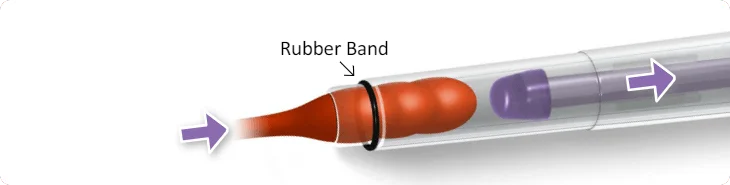
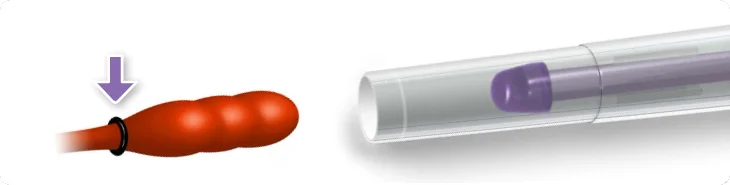
The ligator is inserted into the anus and positioned toward the front of the hemorrhoid tissue.
The purple plunger in the ligator is then pulled backward applying suction to the tissue. The hemorrhoid is then sucked up inside the ligator.
The rubber band slides over the hemorrhoid and is positioned at the base of the tissue. The hemorrhoid will then fall off within a few days, due to the lack of blood flow.
Believe it or not everyone has hemorrhoids. We only tend to hear about them when they are causing issues. Hemorrhoidal tissue is a normal part of our body and is located about two inches inside the anal canal and extends around the outside of the anus. Hemorrhoids are blood vessels that act as seals at the end of the rectum, but at times can overfill with blood and swell, which creates problems. This causes an obstacle for stool to normally pass through the rectum and can cause symptoms like rectal itching, pain and bleeding.
What causes of hemorrhoids?
Some causes of hemorrhoids include:
Prolonged sitting (in a chair or on the toilet)
Chronically strained bowel movements (i.e. constipation or diarrhea)
Heavy lifting
Obesity
Advanced age
Are there different types of hemorrhoids?
Yes. There are internal hemorrhoids and external hemorrhoids.
Internal hemorrhoids can become inflamed on the inside of the anal canal. This is normally not painful but may itch and bleed. At times, an internal hemorrhoid can become so overfilled with blood it may push its way past the anal sphincter, commonly called prolapsed hemorrhoid. This type can retract back into the anal canal on its own or be gently pushed back in.
External hemorrhoids are swollen blood vessels on the skin side of the anal canals. These hemorrhoids can itch, bleed and sometimes form a blood clot that pushes against very sensitive skin and nerves around the anus.
How do I treat my hemorrhoids?
Before your appointment, you can use over- the-counter pain medication, try warm sitz baths several times a day and take a stool softener.
For internal hemorrhoids medical therapy is an option, but the most effective treatment is called a hemorrhoid banding. This is a quick five- minute procedure that uses a rubber band litigation technique. This is an in-office procedure and done without the use of anesthesia. Many patients report little to no pain from this quick and straightforward procedure.
For external hemorrhoids, medical therapy or a minor surgical procedure may be performed, this will not be known until your GI specialist examines the area to know if further steps need to be taken.
Why is this a quick procedure?
Unlike surgical procedures, the banding treatment is minimally invasive, requires no sedation and takes less than five minutes.
How can I prevent hemorrhoids?
The most effective way to prevent hemorrhoids is to keep stools soft and to limit toilet time. See the list below for ways to help keep your stools soft:
Drink 6-8 glasses of water/healthy fluids daily.
East high-fiber foods or take a fiber supplement.
Other ways to prevent hemorrhoids include:
Don’t strain when having a bowel movement.
Exercise
Avoid prolonged sitting and limit time on the toilet to <3min.
Will my hemorrhoid treatment be covered by insurance?
Most medical insurances cover hemorrhoid treatment, but we recommend checking with your individual insurance while you wait for your appointment.
Will I need anesthesia for my hemorrhoid banding treatment?
No sedation needed. Hemorrhoid banding is only performed in clinic and not performed during colonoscopy. And the good news is hemorrhoid banding treatments are fast — and many patients report very little pain — if any.
To provide the best experiences, we use technologies like cookies to store and/or access device information. Consenting to these technologies will allow us to process data such as browsing behavior or unique IDs on this site. Not consenting or withdrawing consent, may adversely affect certain features and functions.
Functional
Always active
The technical storage or access is strictly necessary for the legitimate purpose of enabling the use of a specific service explicitly requested by the subscriber or user, or for the sole purpose of carrying out the transmission of a communication over an electronic communications network.
Preferences
The technical storage or access is necessary for the legitimate purpose of storing preferences that are not requested by the subscriber or user.
Statistics
The technical storage or access that is used exclusively for statistical purposes.The technical storage or access that is used exclusively for anonymous statistical purposes. Without a subpoena, voluntary compliance on the part of your Internet Service Provider, or additional records from a third party, information stored or retrieved for this purpose alone cannot usually be used to identify you.
Marketing
The technical storage or access is required to create user profiles to send advertising, or to track the user on a website or across several websites for similar marketing purposes.